Tuesday, February 16, 2010

The God Helmet


THE GOD HELMET

Todd Murphy, 2007
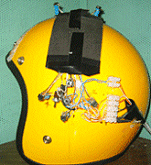


The God Helmet is the popular name given to a laboratory apparatus more correctly called the "Koren Helmet", after Stanley Koren of Laurentian University's Neuroscience Department, who built it according to specifications provided by Dr. M.A. Persinger, director.

The Koren Helmet applies complex (having an irregular shape) magnetic signals to the head of the person who is wearing it.

The Koren Helmet is connected to a PC computer through a 'black box' which cycles the signals through four coils on each side of the head over the temporal lobes of the brain. The temporal lobes are the area of the brain many researchers feel is the source of spiritual and religious experiences. link
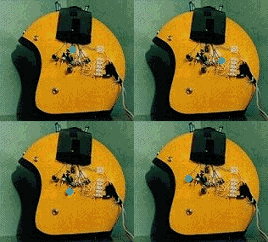
This illustration shows how the signal shifts from one coil to the next. This is a side view. There is also another set of coils working on the other side. The two coils at the top are no longer used.

The sessions are done in an Acoustic Chamber - a completely silent room. A large part of the temporal lobes ongoing activity is dedicated to monitoring ambient sound. The temporal lobes are the source of religious and mystic experiences, so that silence helps a great deal in creating these experiences in the lab.
Used as a research tool to investigate the bran's role in religious and mystic experiences, the Koren Helmet has been given the name God Helmet. A few Journalists gave it this name when they learned that some people had visions of God while participating in Koren Helmet experiments. The name has stuck.
I asked Dr. Persinger how many people had seen God using the Koren Helmet, and this is what he said in reply:
Stanley Koren shows us the most recent version of the God Helmet, which no longer uses a helmet, and has had the unused coils removed.
"The problem is producing an environment in which people will report what they experience without anticipating ridicule on the one hand and not encouraging this type of report (demand characteristics) on the other.
Thus far, about 20 or so people have reported feeling the presence of Christ or even seeing him in the chamber (The acoustic chamber where the experimental sessions took place). Most of these people used Christ and God interchangeably. Most of these individuals were older (30 years or more) and religious (Roman Catholic). One male, age about 35 years old (alleged atheist but early childhood RC (Roman Catholic) training), saw a clear apparition (shoulders and head) of Christ staring him in the face. He was quite "shaken" by the experience. I did not complete a follow-up re: his change in behavior. Of course these are all reports. What we did find with one world-class psychic who experiences Christ as a component of his abilities was we could experimentally increase or decrease his numbers of his reported experiences by applying the LTP pattern (derived from the hippocampus) over the right hemisphere (without his awareness). The field on-response delay was about 10 to 20 sec. The optimal pattern, at least for this person, looked very right hippocampal.


By far most presences are attributed to dead relatives, the Great Forces, a spirit, or something equivalent. The attribution towards along a devil to angel continuum appears strongly related to the affect (pleasant-terror) associated with the experience. I suspect most people would call the "vague, all-around-me" sensations "God" but they are reluctant to employ the label in a laboratory. The implicit is obvious. If the equipment and the experiment produced the presence that was God, then the extrapersonal, unreachable and independent characteristics of the god definition might be challenged."
That's the important thing about the God Helmet. Even if only a few people saw God because of it, it creates a host of new questions - questions theology has never had to face before

The experiences of those who have come face-to-face with God might just be an example of a very rare brain activity. If they actually met the true God, then why did they do so in this experimental setting, but not at other times? Can one control God by controlling someone's brain?
The implications for theology are obvious. Perhaps God exists, but has been waiting until humanity developed enough to find him in the brain before he would appear under any circumstances humans could control. Perhaps God exists only in our brains. Perhaps he exists, and chose to bless 1% of Dr. Persinger's research subjects with visions of him, because these people were believed to him.

Perhaps he exists, but he appears to those with the right neural history in moments when the right pattern of brain activity is present, and not according to what he sees in their hearts.


There is much more to the God Helmet than just the Koren Helmet alone.

There is also a computer program called complex, authored by Stanley Koren, which allows the computer to create the signals. These signals are derived from EEG traces that appear in certain parts of the brain. Just as the brain responds to chemicals with specific shapes, it also responds to magnetic signals with certain shapes.
Because these signals are complex, irregular things, it takes a special computer program to produce them.
A third component is the acoustic - completely silent - chamber where the sessions take place.
The last component is the 'black box' which converts output from the computer into input for the Koren Helmet. This box (not shown) is a specialized DAC (digital-to-analog converter). It's the core of the technology. The rest of the components of the God helmet are quite common.
The God Helmet is a misleading name. It give the impression that it can produce the experience of God. In fact, only one percent of the subjects had the experience. It also passes over the crucial role of sensory deprivation - above all, the completely silent environment provided for the subjects. In contrast to the one percent who saw God, 80% of the subjects felt a presence of some kind, but did not call it God. Of course, there were probably some subjects who experienced an appearance of God, but were shy about saying they had seen God in a laboratory. That kind of thing is not only intensely personal, but can also get you ridiculed. If you saw god, would you tell your story just as it happened if you thought you weren't going to be taken seriously? A lot of people assume that, just because someone wears a lab coat, they won't believe such a vision can happen, or that it's a sign of a mental illness. Nothing could be further from the truth in this laboratory, but how would these subjects know that? They had been told they would be participating in an experiment to study relaxation response, and the experimenters were very careful not to encourage such glamorous reports.

Stanley Koren, senior technician for the research group for the last 15 years.

The Koren Helmet has also produced visions of demoniac beings, out-of-body experiences, visions of other realities, and a range of other paranormal experiences. It could have been named after any of them, but journalists prefer more sensational names, and you can't get more sensational than God.

One question that comes up often about the Koren Helmet is whether it's possible to obtain one. The Koren Helmet exists only in the laboratory where it was made, and is not available to the public. There is a version of the God Helmet you can obtain; the Shiva Neural stimulation System.


Horizon: Total Isolation

Monday, February 15, 2010

God on the Brain


Rudi Affolter and Gwen Tighe have both experienced strong religious visions. He is an atheist; she a Christian. He thought he had died; she thought she had given birth to Jesus. Both have temporal lobe epilepsy.

Like other forms of epilepsy, the condition causes fitting but it is also associated with religious hallucinations. Research into why people like Rudi and Gwen saw what they did has opened up a whole field of brain science: neurotheology.

The connection between the temporal lobes of the brain and religious feeling has led one Canadian scientist to try stimulating them. (They are near your ears.) 80% of Dr Michael Persinger’s experimental subjects report that an artificial magnetic field focused on those brain areas gives them a feeling of ‘not being alone’. Some of them describe it as a religious sensation.

His work raises the prospect that we are programmed to believe in god, that faith is a mental ability humans have developed or been given. And temporal lobe epilepsy (TLE) could help unlock the mystery.

Vaccination – The Hidden Truth

Vaccination - The Hidden Truth
45:20 - 2 years ago
This is the first half of the shocking but extremely and timelessly informative video documentary "Vaccination - The Hidden Truth" (1998) where 15 people, including Dr. Viera Scheibner (a PhD researcher), five medical doctors, other researchers, and parents' experiences, reveal what is really going on in relation to illness and vaccines. With so much government and medical promotion of vaccination for prevention of disease, ironically the important facts presented here come from the orthodox medicine's own peer-reviewed research, of which a total of well over 100,000 pages has been studied by those interviewed. The result is a damning account of the ineffectiveness of vaccines and their often harmful effects. It shows that parents are not being told the truth by the media, the Health Department and the medical establishment, with a medical doctor, Dr. Mark Donohoe, confessing that "It is a problem for me that I am part of a profession that is systematically lying to people." Find out how vaccines are proven to be both useless and have harmful effects to your health and how they are often erroneously believed to be compulsory. Many people simply refuse to believe the truth regardless of how clear it is, but the impeccable documentation presented in this amazing video has changed the minds of many who have seen it. This first half explains most, but not 100%, of the reason for counterproductive effect of vaccines. The last part of the reason, which also is published in medical research, is in the second half of the video. To view or purchase the whole DVD/video, go to www.vaccination.inoz.com. Please note that this video was very expensive to make and sales and donations support the freely provided Vaccination Information Service, which exists only for the benefit of you and your children.

Vaccination – The Hidden Truth | Watch Free Documentary Online

Vaccination – The Hidden Truth | Watch Free Documentary Online

Posted using ShareThis

Monday, February 1, 2010

Right Brain vs. Left Brain

Right Brain vs. Left Brain

Definition
This theory of the structure and functions of the mind suggests that the two different sides of the brain control two different “modes” of thinking. It also suggests that each of us prefers one mode over the other.
Discussion
Experimentation has shown that the two different sides, or hemispheres, of the brain are responsible for different manners of thinking. The following table illustrates the differences between left-brain and right-brain thinking:
Left Brain
Right Brain
Logical
Sequential Rational
Analytical
Objective
Looks at parts
Random Intuitive
Holistic
Synthesizing
Subjective
Looks at wholes

Most individuals have a distinct preference for one of these styles of thinking. Some, however, are more whole-brained and equally adept at both modes. In general, schools tend to favor left-brain modes of thinking, while downplaying the right-brain ones. Left-brain scholastic subjects focus on logical thinking, analysis, and accuracy. Right-brained subjects, on the other hand, focus on aesthetics, feeling, and creativity.
How Right-Brain vs. Left-Brain Thinking Impacts Learning
Curriculum–In order to be more “whole-brained” in their orientation, schools need to give equal weight to the arts, creativity, and the skills of imagination and synthesis.
Instruction–To foster a more whole-brained scholastic experience, teachers should use instruction techniques that connect with both sides of the brain. They can increase their classroom’s right-brain learning activities by incorporating more patterning, metaphors, analogies, role playing, visuals, and movement into their reading, calculation, and analytical activities.
Assessment–For a more accurate whole-brained evaluation of student learning, educators must develop new forms of assessment that honor right-brained talents and skills.
Reading
Bernice McCarthy, The 4-MAT System: Teaching to Learning Styles with Right/Left Mode Techniques.
The content on this page was written by On Purpose Associates.

http://www.funderstanding.com/content/right-brain-vs-left-brain

Thursday, January 14, 2010

The Meaning of Sex: Genes and Gender

From the 2001 Holiday Lectures — The Meaning of Sex: Genes and Gender

Evolution of the Y Chromosome

How did the human Y chromosome become so small relative to its X counterpart? This animation depicts the 300-million-year odyssey of the sex chromosomes that began when the proto X and Y were an identical pair.
5 minutes 38 seconds
Play Large: MOV / WMV (11 MB)
Play Small: MOV / WMV (6 MB)
To download the videos, in Internet Explorer right-click the link and select "Save Target As..." In Firefox right-click and select "Save Link As..." In Safari right-click and select "Download Linked File As..."
More About Evolution of The Y Chromosome
Background
The human X and Y chromosomes are a unique pair. The other chromosome pairs, called the autosomes, appear to be identical twins; they are superficially indistinguishable. In contrast, the X and Y chromosomes appear to be vastly different from one another. Why are the sex chromosomes so different? How did they get that way?
The Y chromosome is only one-third the size of the X. Although the Y has a partner in X, only the tips of these chromosomes are able to recombine. Thus, most of the Y chromosome is inherited from father to son in a pattern resembling asexual, not sexual, reproduction. No recombination means no reassortment, so deleterious mutations have no opportunity to be independently selected against. The Y chromosome therefore tends to accumulate changes and deletions faster than the X. Degradation doesn't occur in X chromosomes because during female meiosis, the X has the other X as a full partner in recombination.
Clues of how the Y chromosome evolved can be found by comparing the genes and the sequences of X and Y chromosomes as well as homologous genes of different species. One method scientists use to estimate evolutionary time is observing how homologous genes have become different over time in different species. All DNA sequences accumulate random mutations over time, so species that are distant relatives should have more different sequences than close relatives because they have been evolving separately for a longer time. Once recombination stopped between portions of X and Y, genes located on those parts started to evolve separately as homologs. Apparently, this happened in stages, so some X-Y gene pairs are more related than others, meaning they stopped recombining more recently. Also, chunks of genes stopped recombining, and by mapping their positions on the chromosome, one can guess that an event, like an inversion, may have taken place.
Travel back in time, when human ancestors were reptile-like forms, and peer into the processes that shaped the X and Y chromosomes.
Introduction
How did the human Y chromosome become so small relative to its X counterpart? This animation depicts the 300-million-year odyssey of the sex chromosomes that began when the proto X and Y were an identical pair. Over time, structural changes in the Y chromosome resulted in its current form, which is specialized to trigger male development. The evolutionary timescale is represented by positioning the chromosomal remodeling events along an abbreviated vertebrate cladogram, a chart of evolutionary relationships.
(Ma = million years ago)
Part 1. Sex chromosomes originated as autosomes
The sex chromosomes began as an ordinary pair of autosomes. During meiosis. chromosomes replicate their DNA, pair, and exchange genes (recombination; red lines). A mutation in the SOX3 gene produced the SRY gene, a critical determinant of maleness, on the proto Y. While the functions of SRY and SOX3 became very different over time, another gene, RPS4, retained a similar function on both the X and Y chromosomes.
Part 2. Inversions restrict recombination between the X and the Y chromosome
Inversions, which are internal recombination events, caused a rearrangement of genes on the Y chromosome. These rearrangements meant that large portions of the X and Y chromosome no longer recombined, which made the Y chromosome susceptible to deletions, and it decreased in size.
Part 3. Comparison of sex-chromosome recombination in males and females
After our lineage diverged from the ancestors of the monotremes, such as the duck-billed platypus, another inversion further scrambled the genes on the proto Y. In males, only the tips of the Y chromosome were left able to recombine with homologous genes on the X chromosome. In contrast, in females, recombination continued to occur across the full length of the two identical X chromosomes.
Part 4. Autosomal expansion of X and Y chromosomes
About 130 million years ago (Ma), an autosome donated a block of genes that extended the length of both the X and the Y chromosome. The X and Y were able to recombine in these expanded regions of the chromosomes. Subsequently, inversions rearranged the order of genes on the Y chromosome. Additional rearrangements occured almost exclusively on the Y. Without recombination to preserve its integrity, the Y continued to lose genes and, over time, shrank.
Part 5. An autosome contributed a copy of the DAZ spermatogenesis gene to the Y chromosome
Sometime after squirrel monkeys diverged from the primates that evolved into humans, an autosome contributed a copy of the DAZ spermatogenesis gene to the Y chromosome. The DAZ gene was copied and copied again and now the modern Y chromosome contains four identical DAZ gene sequences. The modern Y chromosome is about one-third the size of its X-chromosome partner.
Learn More: Autosomes
An autosome is any chromosome that is not a sex chromosome. In ancient reptilian creatures, there was no chromosomal basis for sex determination. Scientists speculate that sex was determined by environmental factors such as temperature. Some modern reptiles, including turtles and crocodiles, still use this mode of sex determination.
Learn More: DAZ
Many genes essential for the production of sperm are located exclusively on the Y chromosome. One of these genes, DAZ (deleted in azoospermia), was copied from an autosome and was copied twice on the Y chromosome, resulting in four copies of the DAZ gene. The Y chromosome is unique because not only are male spermatogenesis genes sequestered on the Y, but they exist as mutiple copies. In fact, the abundance of multiple copies and mirror images of sequences have led researchers to call the Y chromosome a "hall of mirrors." Although this sequence repetition created great challenges in the sequencing of the Y chromosome, the complex structure also serves an important purpose. Multiple copies of essential spermatogenesis genes ensure that in spite of deletion events, which may result in the loss of a single copy of an essential gene, spermatogenesis can still proceed via proteins produced by remaining copies.
Learn More: Deletions
Deletions are uncommon, but relative to inversions, they are not rare events. (Recombination, however, is a common event). Deletions occur particularly in regions of the Y chromosome that do not undergo recombination. The chromosome is mutated, causing a section of DNA to be excised, and the two flanking ends of DNA join to form a continuous strand.
Learn More: Expansion
About 130 Ma, an autosome donated a block of genes that extended the length of both proto X and Y (expansion). The proto X and Y were able to recombine in these expanded regions of the chromosomes. Subsequently, inversions further rearranged the order of genes. Without recombination that preserved the integrity of chromosomes, the proto Y lost genes and, over time, shrank in size.
Learn More: Inversions
On an evolutionary timescale, large inversions, such as those shown in the animation, are actually very rare events. To occur, the DNA at one end of the chromosome recombines with DNA at the other end of the chromosome, forming a loop. Instead of the loop being eliminated from the chromosome (as happens in other types of recombination events), the loop twists. Therefore, the same DNA sequences are retained in the chromosome, but their orientation is reversed. Scientists speculate that large inversions resulted in the relocation of SRY to the "top" of the Y chromosome relative to its former partner SOX3, which remains near the "bottom" of the X chromosome.
Learn More: Meiosis
To produce sperm or eggs, germ cells undergo the process called meiosis. Chromosomes replicate and pair up, resulting in a 4n quantity of chromosomes. Two nuclear divisions follow, so that the gametes have a haploid (1n) number of chromosomes.
Learn More: Mutation
Mutations are alterations in the DNA sequence that occur randomly and can have little or great consequences, depending on the location of the mutation. When a mutation altered SOX3, the testes-determining gene SRY resulted. This mutation had great consequences: The evolution of unique sex chromosomes began.
Learn More: Recombination
During meiosis, chromosomes with substantial DNA sequence homology will pair and exchange pieces of DNA, a process called genetic recombination. This process provides not only a source of genetic variability but also a way in which deleterious mutations are eliminated by not being passed on to future generations. (Recombination allows for reassortment and thus a way for selecting out deleterious mutations without needing to eliminate the entire set of alleles on which the mutation arose.) In this way, recombination preserves the integrity of the chromosomes. The X and Y chromosomes are notably different with respect to recombination. During female meiosis, the two X chromosomes undergo recombination throughout their entire length (illustrated by red lines). In contrast, during male meiosis, the Y chromosome recombines with the X chromosome only at its tips. Thus, over time, deleterious mutations accumulate in the nonrecombining regions of the Y chromosome.
Learn More: RPS4
RPS4 (ribosomal protein small subunit, protein 4) is a gene essential for ribosome formation. Identical copies of RPS4 are found on both the X and the Y chromosome, and the same function has been retained over timeósince before the creation of SRY and through millions of years of divergence between the X and Y. However, the location of RPS4 has changed as a result of a large inversion.
Learn More: SRY
The SRY gene regulates the formation of the testes from the undifferentiated embryonic gonad. The location of SRY and SOX3 on the X and Y chromosomes of several species has been compared, an analysis that has allowed scientists to roughly date when changes occurred. Gene pairs, such as SRY and SOX3, allow researchers to map changes and rearrangements on chromosomes. Specifically, 300 million years ago (Ma), scientists speculate that SOX3 was in the same location on the proto X and Y chromosomes. A mutation in SOX3 created the gene SRY on the Y chromosome. Researchers found that monotremes are the most ancient mammals that have the SRY gene, whereas all earlier ancestors do not. These data allowed researchers to estimate when the mutation that created SRY occurred.
Learn more about SRY at: "Gender Testing of Female Athletes"
http://www.hhmi.org/biointeractive/gendertest/gendertest.html


(copied without permission from http://www.hhmi.org/biointeractive/gender/Y_evolution.html